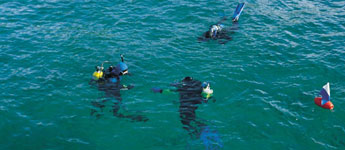
| The underwater
world of Port Phillip Bay includes over 60 nineteenth century shipwrecks and
four sunken submarines from World War One. Come face to face with
sea-dragons, seahorses and gardens of exquisite soft corals and experience
the diversity of one of the most colourful and interesting underwater
habitats in the world.
Diving in Port Phillip Bay is suitable for all
divers, from beginners through to those who are very experienced. It is
recommended that if you have not dived in Victoria, that you take an
organised tour or dive with a guide.
Check out the below recommended dive sites:
Popes Eye
Popes Eye is one of the smallest marine reserves in Australia, and
home to abundant marine life. Originally built in the late 1800s as an
island fort to defend the Port of Melbourne against the Russians, it is now
just a ring of rocks that is a sanctuary for many species of marine life
including fish, birds and seals.
Diving at Popes Eye requires
knowledge of the tidal flows, which can be very fast in this area. However,
the rocks form a natural barrier against the current and it can be dived in
almost all conditions.
Depth – 12 metres
Rating – Level 1 (Snorkel or Open Water diver)
Kelp Beds Reef
Set out in 8 metres of water to explore the amazing underwater
cliffs, ledges and caves that descend to Kelp Beds Reef and a depth of about
18 metres.. As the name suggests, the shallower sections of the dive are
covered in kelp, and as you descend the walls come to life with colourful
sponges and corals. Kelp Beds Reef is home to many species of fish, and must
be dived at slack water due to its close proximity to Port Phillip Heads.
Similar dive sites to Kelp Beds Reef are Boarfish Reef and 12lb Reef.
Depth – 8–18 metres
Rating – Level 2 (Open Water diver)
Wall dives and drop-offs
Port Phillip Heads are home to some of the most spectacular wall dives in
Australia. These walls start at a depth of about 12 metres and extend beyond
90 metres. The caves, ledges and overhangs of these walls are adorned in
marine life and are spectacular.
These walls need to be dived at
slack water and divers need to be aware of their depths at all times. Some
other dive sites located on walls are Lonsdale Wall, Spectacular Reef,
Nepean Wall, Rip Bank, The Caves, Foggy Reef and many more.
Depth – 12–40 metres +
Rating – Level 3 (Advanced Open Water)
The Eliza Ramsden wreck
The Eliza Ramsden hit Corsair Rock in Port Phillip heads and
stuck fast on the reef on return from its maiden voyage in 1875. The crew
was rescued, the ship re-floated on the incoming tide and was washed into
the bay where it sank. Because of its close proximity to the shipping
channel, it was blasted, but the bow and parts of the hull still remain
intact. This also means that it can only be dived at slack water when there
is no shipping traffic, making it a difficult dive to get on to, but worth
the effort.
Depth – 21 metres
Rating – Level 3 (Advanced Open Water)
WW1 J Class submarines
After World War 1, the British Navy supplied the Australian Navy with six
submarines. These 84-metre submarines had three drive shafts and an
underwater speed of 19.5 knots. The vessels did not see action after the war
and were scuttled in 1926. At present four of the submarines lie outside
Port Phillip Heads in water between 26 and 40 metres. These dive sites are
deep and special training is required to penetrate the wrecks. The other two
subs lie in shallow water inside the bay, making them very accessible to
divers.
Depths – 26–40 metres
Rating – Level 3 (Advanced Open Water) and Level 4 (Deep Diver)
Ships' Graveyard
The Ships' Graveyard is located about 20 minutes by boat from Port Philip
Heads. There are many ships in the Graveyard with depths ranging from 40-70
metres, giving technical divers the ideal playground to explore. There are
still many shipwrecks in the Graveyard that are still to be found. Fantastic
wrecks in the Graveyard include The Pioneer (50 metres), The Euro (48 metres)
and VHB Barges.
Depth – 40–70 metres
Rating – Level 5 (Technical Deep Diver)
Portsea Pier
Located at the end of the Mornington Peninsula, Portsea is the home of
Victorian diving. Most of the diver training takes place here, and the site
is a popular shore dive for its sea dragons, rays and nudibranchs. To the
left of the pier is a reef system that stretches out under the boat
moorings. This is also where dive boats leave from, so always be aware of
boat traffic and stay under or to the left of the pier.
Maximum depth – 6 metres
Rye Pier
Rye pier is home to Victoria’s first underwater trail. This trail is
suitable for snorkelling and diving and takes you on a marine life tour.
Entry is from the low platform halfway down the pier where there is
sufficient depth to start your dive. Many species of marine life can be
found here.
Maximum depth – 6 metres
Mornington Pier
A reef system extends on Schnapper Point, which can be incorporated into
your dive. With parking next to the pier, this is a very easy dive to
complete. Entering and leaving the water can be difficult as it involves
moving over rocks. Another reef extends from Point Linley at the Boat Ramp.
Be aware of boat traffic and always use a divers float and flag.
Maximum depth – 10 metres |